


News


Often referred to in the history of some civilisations as “white gold”, salt was once a mineral so precious and vital to human survival that it shaped trade routes, influenced the development of societies, and played a role in the rise and fall of empires. Its economic significance was so profound that it impacted military strategies and even sparked conflicts and wars. In some early civilisations, salt was used as a form of currency and was a symbol of wealth (the Latin salarium means “payment in salt”). Today, while salt is no longer a rare commodity, ancient forms like Baleni salt continue to capture interest for their distinctive origins, uses and cultural significance.
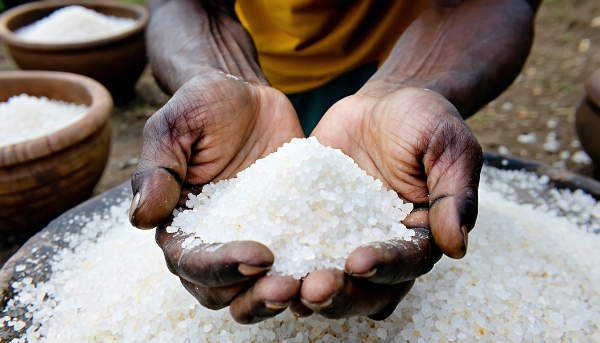
Preserving ancient traditions
Within a Natural Heritage Site in the north-eastern region of South Africa, there lies a geothermal hot spring where the indigenous Tsonga community continue a 2000-year-old traditional process of harvest in order to yield sacred “Baleni” salt.
When ancient ancestral traditions produce these magical grains, they enter the modern kitchen in the hands of chef Vusi Ndlovu, co-owner of Edge restaurant, with assured aplomb. Taking up residence on the popular Shortmarket Street in Cape Town’s inner city, Edge is a showcase of proud prepossession for the often ignored and underexplored, describing its mission objective as: “The work of taking African ingredients out of obscurity and placing them in the spotlight in order to honour and uplift the vibrant life of the African pantry, using flavour as a vehicle for information.”
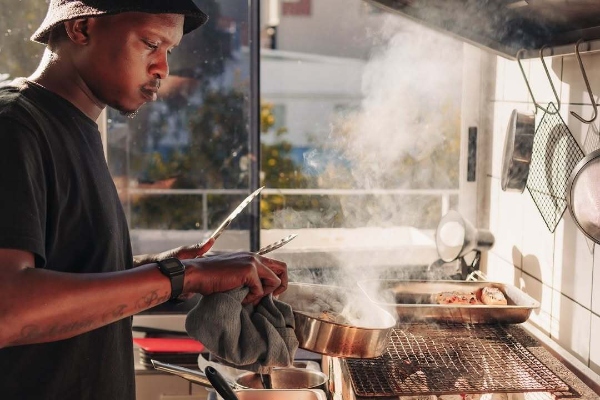
Chef Vusi Ndlovu
With his creative craft seamlessly delivered in allegiance with unique storytelling of our continental ingredients, Vusi plays his vital part in ensuring that special and unique African ingredients, like Baleni salt, are continued and not lost to time. “The discovery of unique ingredients is the best part of cookery – it keeps us curious and feeds that desire for further growth, understanding and continuous learning. Baleni salt came onto our radar a few years ago when we were doing some research in the north of South Africa, and the story of their salt harvest was something that really spoke to our purpose,” he says.
Process to preparation
Baleni salt production is a dry-season activity, occurring from May to September each year when the water levels that run from the Klein Letaba River into the Baleni catchment are at their lowest. This leaves behind a white salt-rich crust on the newly exposed surface. After collecting the salt crust, it is mixed with an equal amount of river sand, which helps to loosen and break down the texture of the large salt-crust pieces. The mixture is then placed into a basket-type filter with a water catchment underneath it, and water is then poured over the mixture multiple times to yield the desired content of salt brine in the catchment. The salt brine is then gently boiled to evaporate the water, which leaves behind the sought-after salt crystals.
Vusi’s processes of working with Baleni salt in his kitchen productions might be less labour-intensive, but can often be just as time-consuming, explaining: “Salt is the core ingredient in most, if not all, of cooking – it’s involved in the beginning, middle and the end as a ‘finisher’ to make final adjustments. Some of our kitchen production can be very lengthy when curing or brining Ingredients. Keeping various proteins submerged in salt brines can often take days before they’re ready for the next step in their preparations, but our salt dry-curing methods will take even longer: it takes weeks before they’re ready.”
The architect of flavour
It might seem to be a very odd thing to describe a certain salt as tasting “very salty”, but there are varying levels to the concentration of minerals found within all salts that do make it more, or less, so. Baleni salt’s unique flavour is slightly earthy and somewhat sharp, with its bold intensity being attributed to the traditional, unrefined method of its harvesting from the mineral-rich earth.
However, salt isn’t only for the savoury and Vusi cleverly illustrates this with its slight addition to his “Dark Chocolate, Orange and Malt” dessert that unlocks remarkable brilliance of flavour exploration at Edge. The creativity shown in kitchens today reflects ambitious and wonderfully surprising experiments in the juggling of combinations in salt, saline and acidity balancing acts – in so far that it has also crossed territories into clever and unique bar programmes and beverage offerings. “We’ve begun incorporating Baleni salt into really clever cocktail concoctions, and it’s worked out really well! Because Baleni salt is not your typical iodised salt, we could seriously taste the difference in the comparative tests that we did, and it made a huge difference to our results,” says Vusi.
As we see a growing number of South African chefs and restaurants gloriously displaying strong statements of purpose for celebrating our unique indigenous African ingredients, this will prove to be a crucial and vital step towards showcasing our cultural diversity to the broader audience.
Baleni salt – an ingredient that is so proudly ours, a product that was once so highly valuable as a commodity and symbolic of stature in powerful ancient empires – has a high value that is not lost in the present day. With its versatility of ever-broadening uses, it has pivotal importance in the most basic of any foundational cooking.
Salt remains salient.


Related posts
-

-
Creating connection: Sommelier Tinashe Nyamudoka on finding beauty in wine
-
It's never just a drink with...
-
-
-
Enter now: The S.Pellegrino Young Chef Academy is open for applications
-
It's more than a culinary...
-
-

-
Announced: The Eat Out Special Awards
-
Stay updated on the Eat Out Woolworths Restaurant...
-
Promoted Restaurants
-

3 Kitch3ens at Silver Forest
3 KITCH3NS is a vibrant colourful Restaurant and Bar based at the Beautiful Silver Forest, at the foot of the Helderberg Mountain surrounded by Trees. As the name...
-

Vivace Bar & Restaurant at Radisson Blu (Sandton)
Located on the 13th floor, Vivace Bar & Restaurant offers patrons striking views of Sandton City and Johannesburg alike. Complement your meal with a variety of...
-

Taste of Thai
The Most Authentic Thai Restaurant in South Africa Our Multi Award winning establishment offers a little genuine glimpse of Thailand in Hilton. through a journey of...
-

Stellenzicht Wine Pod
Our Wine Pod is our unique tasting room on our estate. It was designed to bring nature into the structure. Because of this, when you are enjoying a glass of elegant...
-

Grande Roche Restaurant
Grande Roche Restaurant is a grand old lady with a fresh set of pearls and vibrant lipstick. Chef Kevin’s food style is an ever evolving feeling and depends...
-

Harald’s Bar & Terrace
This relaxing venue is an ideal spot to enjoy a cocktail, wine, or beer in a fun-filled atmosphere. Take in splendid views of Table Mountain and savour tasty...