


News
Star flavours: how Vanessa’s Chicken at The LivingRoom celebrates KZN, nostalgia and offal
Monday, June 16th, 2025

As we continue to reveal the stories behind seven special dishes from our three-star restaurants, this week we turn to Vanessa’s Chicken from The LivingRoom at Summerhill Guest Estate.
A continuously evolving plate of food, it’s been on the menu for the last six years and perfectly highlights the restaurant’s commitment to serving exceptional food that champions seasonality and sustainability while honouring the diversity of the produce available in KwaZulu-Natal.
Winner of the 2025 Eat Out Woolworths Green Star Award, The LivingRoom demonstrates an unwavering focus on sustainable practices in all aspects and is a guiding light for an environmentally, socially and financially sustainable future.
Chef Johannes Richter, who is also the Eat Out Woolworths Financial Services Chef of the Year, gives us the lowdown on how this dish came to be and what the breakthrough moment was in its creation.
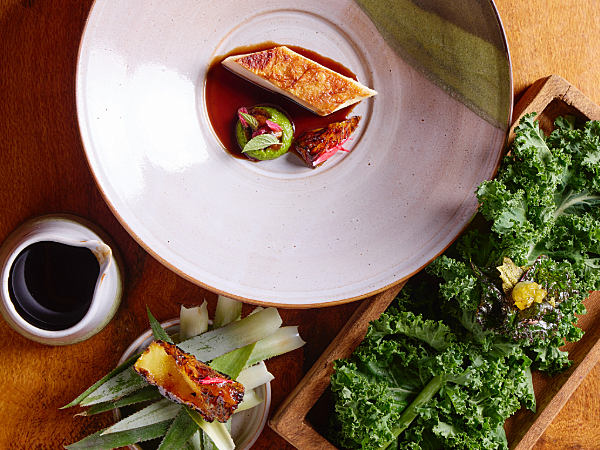
The dish
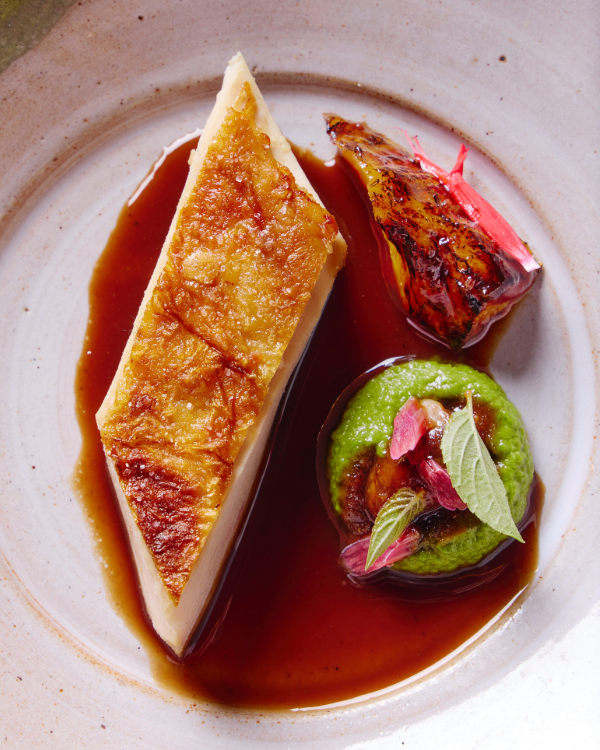
Chicken breast served with chicken heart slow cooked in pineapple juice, a chicken liver parfait with a sweet pineapple chutney served between kale chips, and a jus that’s finished with chicken feet.
What inspired this dish? Is there a personal story or specific influence behind it?
The inspiration was quite straightforward. At the beginning, we faced two major challenges: one was recruiting and training front-of-house staff, and the other was finding high-quality produce that also aligned with our ethics.
Then we found Vanessa, who supplied this beautiful poultry. Initially, we were looking for duck. Being classically French-trained, poulet – chicken – is, of course, something that is quite high up there, so it just made sense to go in that direction and feature a chicken dish. I can’t even say how many variations we’ve created, but I’d estimate over 50 different versions using Vanessa’s chicken over the past five or six years since we started working with it. The ingredient has definitely become something of a signature for us.
What are the key ingredients and why were they chosen?
Currently, the dish is served with kale from Deon and Chisomo [Bean’s] farm – our go-to supplier for organic fruit and vegetables in the Midlands – and pineapple from the more subtropical coastline of KwaZulu-Natal – these really lovely, fruity Queen pineapples.
The inspiration here is twofold: firstly, to showcase seasonality; and secondly, to highlight the diversity of the produce available in our region. That’s really the driving force behind it – bringing together the Midlands and the subtropics in one dish, using this amazing chicken and exceptional produce.
Are there any unexpected ingredients or flavour combinations that make the dish unique?
I like to think the uniqueness is definitely there. For one, we try to showcase the whole chicken. In addition to the main component, we include a piece of chicken heart that we’ve slow cooked in pineapple juice, a chicken liver parfait with a sweet pineapple chutney served between kale chips, and a lighter jus that’s finished with chicken feet – really bringing all that lovely texture into the jus.
And then, of course, the combination of kale and pineapple is also quite unique. This is largely due to our location, which allows us to source beautiful, more continental produce from the Midlands, as well as all these lovely subtropical ingredients from the coastline.

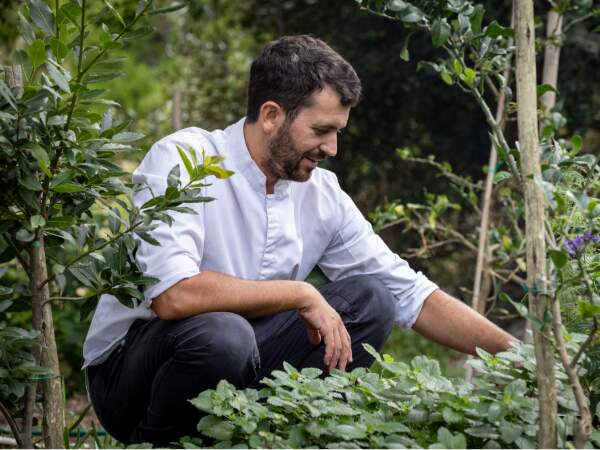
Chef Johannes Richter
What’s the most technically challenging part of making this dish?
I think the technical challenge lies in using the whole bird – it is true nose-to-tail cooking. It’s all about ensuring that all the parts we include in a particular version of the dish are prepared absolutely perfectly.
I think the trickiest part, which ironically might seem the simplest, is preparing the chicken breast. It can dry out incredibly quickly, so we cook it at a low temperature. Before that, we dry-age it for five to seven days, depending on the size of the bird.
We render the skin to get it nice and crisp, and then we give it a quick finish with butter. After cooking, we give it time to rest so we don’t lose all those lovely juices when we cut into it.
Is there a particular technique or piece of equipment essential to its preparation?
We have a low-temperature oven that consistently holds at around 70 degrees. We want the core temperature of the chicken to gradually reach about 63 degrees over the course of ninety minutes, and without that piece of equipment, it would definitely be more challenging.
That said, when we prepare it outside of The LivingRoom, we’ve also done it entirely in a pan. We start with a low to medium heat, focusing first on getting the skin nice and crispy, and then finish it off by basting it with butter. Classic French.
Did this dish go through multiple iterations? What changed and why? How long did it take to perfect the final version?
As cooking with seasonal produce is one of the core principles of our concept, our menu – which is always in flux – completely changes about eight times a year – twice per season. So, dishes are constantly developing and evolving.
Fortunately, we’ve got a team that shares my outlook and ethos and has made it their own. In that sense, when new ideas come in and we start developing new dishes, we’re quite efficient at trialling and refining them. We’re used to thinking on our feet and, of course, cooking seasonally.
I’d say it took us about a week to arrive at the final version we have on the menu right now. And, as I mentioned earlier, we’ve probably gone through around 50 different versions of this chicken dish over the past six years.
Was there a breakthrough moment in developing it?
I think the breakthrough moment came when we made these different types of kale chips and created a kind of mille-feuille with chicken liver parfait and pineapple chutney. When we tasted it, we got this lovely savouriness from the kale, the sweetness of the pineapple with just a touch of spice, and then, of course, that umami and creaminess from the parfait.
When we tasted it, we thought, “yeah, okay, this is definitely heading in the right direction. This definitely works.”
Did you test it with your team or guests before putting it on the menu?
Yeah, absolutely. We test everything as a team. It’s quite a rigorous process. First, we test each ingredient and component of the dish individually, then we test the plating, and finally we assess how it all comes together as a whole. From there, we make small tweaks as needed.
There’s a lot of play with sweet, sour, and savoury elements – that’s a flavour profile we love to use, especially in our more umami-driven dishes. I always try to make sure we hit the right kind of bliss point there.
Is there a specific way you would like guests to eat or interact with the dish?
Yeah, I think at first, for many guests, it can be a bit daunting to have something like a chicken foot jus or to eat a chicken heart – and sometimes even the liver parfait. So, I’m always really, really stoked when it’s embraced and our guests step out of their comfort zone to discover just how good well-prepared offal – or ingredients they might not usually eat – can be.
What does this dish say about your approach to cooking or your culinary philosophy?
Well, it draws on one of the core pillars of our philosophy – KwaZulu-Natal’s culinary diversity. This dish, in particular, showcases our location beautifully by highlighting the richness of Durban and its surroundings.
On one side, we have the lush subtropical coastline, which gives us all these beautiful subtropical ingredients. On the other, we have the Midlands. Bringing those elements together and showcasing them in a single dish is, I think, really special and unique, as well as hopefully being something that flows through our entire menu.
What do you want guests to feel as they’re eating it?
I think what’s really surprising is how the sweet and savoury elements mix in this dish. It’s all underlined by a subtle kick of spice from the banana chillies we grow in our garden.
For me, that’s the really interesting part – exploring this flavour profile that’s actually quite classic for South Africans, where there’s often a tendency to mix sweet and savoury, like with chutney and similar things.
And I think that’s where another pillar of our philosophy – nostalgia – really comes into play. You’ve got this deeply savoury dish that’s lifted by a lovely underlying sweetness, tropical notes, and fruitiness. It definitely taps into nostalgia – perhaps not through the ingredients themselves, but through the overall flavour profile.
Book your table at The LivingRoom so you can experience the nostalgia of this dish for yourself.
-

 chefs
chefs
-
chefs South Africa
-
Johannes Richter
-
KwaZulu-Natal
-
Star flavours
-
The LivingRoom
-
The LivingRoom at Summerhill Guest Estate
-
Vanessa's Chicken
Related posts
-

-
Margot Janse on giving back through food
-
Watch our interview with the...
-
-
-
The three restaurants setting the standards for sustainability in SA
-
Celebrating sustainability...
-
-
-
WATCH: Ryan Cole on being voted the Chefs’ Chef
-
We sat down with the chef to get his insights....
-
Promoted Restaurants
-

Grande Roche Restaurant
Grande Roche Restaurant is a grand old lady with a fresh set of pearls and vibrant lipstick. Chef Kevin’s food style is an ever evolving feeling and depends...
-

Rust en Vrede Restaurant
Chef Fabio Daniel’s ingenuity lies in his ability to put his Italian-Brazilian heart on a plate using fresh South African ingredients and classic French...
-

Harald’s Bar & Terrace
This relaxing venue is an ideal spot to enjoy a cocktail, wine, or beer in a fun-filled atmosphere. Take in splendid views of Table Mountain and savour tasty...
-
Zest Restaurant
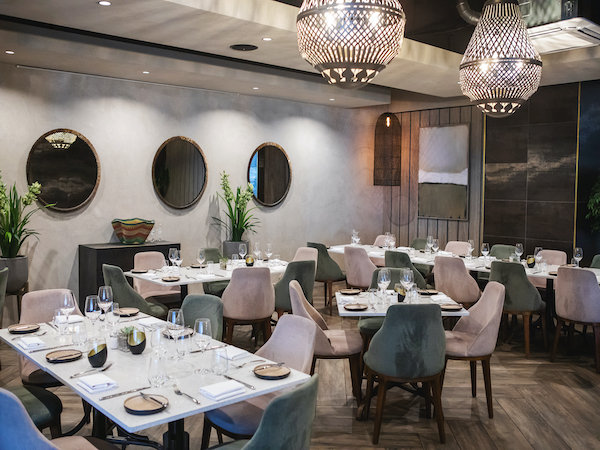
At Zest Restaurant the chefs work behind the open plan kitchen, with its wood fire grill, and can be seen whilst creating delectable dishes. Diners are able to...
-


Judd’s Local
Judd’s Local is a family run business founded in 2017 by Erna Judd & Bryan-John Judd. Starting with a small bakery in the winelands, the Judd’s decided to...
-

The 11th Floor
ROOFTOP RESTAURANT & COCKTAIL BAR IN BEDFORDVIEW Step into a realm of culinary excellence at our international award-winning restaurant, and be transported to the...