


News
How climate change is impacting restaurant wine lists in South Africa
Tuesday, February 24th, 2026

When dining at a restaurant, heat is part of the process. But hot food is far more preferable than the effects of a heating planet on your wine.
Climate-related challenges such as heat, drought, frost, fire and storms can have an impact on wineries’ ability to supply restaurants consistently.
According to co-founder of Winelab and WSET educator Andrew Shelly: “In the Western Cape, changing rainfall patterns are shifting how we need to farm grapes. Summer thunderstorms are becoming more frequent, increasing disease pressure and diluting concentration at harvest. Increased warmth brings more ripeness, but a more compressed growing season introduces new challenges such as increased risk of spring frost damage. The wine world is responding by breaking tradition and introducing alternative varieties into classic regions. Our own producers started years ago experimenting with warm-climate varieties to improve sustainability in spite of global warming.”
Johan Reyneke, owner and viticulturist of Reyneke Wines, describes the effect of climate-related challenges on the wine industry’s ability to supply restaurants. He says thus far Reyneke Wines has been lucky to escape fire hazards which would have a catastrophic effect. He says that drought is probably a more regular occurrence than previously and here high humus levels in the soils, which improve water retention ability, play a significant adaptation role. Johan says: “Our new vineyard developments also follow key-line designs thanks to the forward-thinking Rosa Kruger. These allow vineyard development to follow the natural contours of the land and allow farmers to harvest excess water runoff in the winter months.”
In order to maintain balance and quality, Johan says: “We consistently refine our regenerative farming efforts as they play a significant role in both climate change mitigation and adaptation.”
Another organic winery’s founder, Alex Dale of Radford Dale, explains that harvest timing has changed dramatically over the last three decades.
“Harvest timing has changed dramatically. When I first moved to South Africa from Burgundy in 1994, harvesting would commence during the first half of February (occasionally later) and would end sometime in late March or most often in early April. In 2026, by contrast, we started harvest on 9th January! Our earliest ever. We have started in January every year for about seven or eight years now (but never before then). So, we now start harvest up to a month earlier than when I arrived, just 32 years ago. That is a dramatic change. It’s the same in Burgundy too; harvesting now commonly starts in August, as opposed to September or October, when I was a youngster,” Alex says.
According to Alex, yields naturally fluctuate, and while it’s difficult to quantify the overall impact of climate change on crop production, drought – particularly in dry-grown vineyards – has a significant effect, as seen during the 2016–2018 drought when some vineyards in the Swartland did not survive or were removed due to poor economic viability. Rainfall and irrigation are critical to maintaining yields, and when water is unavailable during key growing stages it severely reduces production, making lack of rainfall more immediately impactful than temperature increases, although rising temperatures remain a concern.
From a restaurant perspective, Wikus Human, Wine Director at Marble Hospitality, considered the 2016 vintage as a drinking vintage, 2017 as a bit underrated, but thinks it will compete with 2015 in the long run and 2018 again as a drinking vintage.
Wikus says that climate change is a factor when it comes to the availability of the wines.
Whilst there aren’t specific regions or producers that Marble Hospitality has had to remove from the list, Wikus says, “It’s more a case of receiving smaller allocations – essentially, less wine being available. If it’s a great vintage, we might store the wine. If it’s more of a drinking vintage, we’ll list it immediately.”
“That’s also why Marble’s wine list is electronic. It allows us to adjust quickly. If we only receive six bottles of something, we can update the list weekly to keep it current. With very small allocations, it becomes first come, first served,” Wikus says.
Sam Ross, sommelier at Salsify, says: “Climate change isn’t just about things getting warmer; it’s more about how unpredictable everything has become. Heat spikes, sudden rain, shorter seasons. All of that has affected consistency. Not that long ago, the Cape was known for being reliable from one vintage to the next. That’s not really the case anymore.”
Wineries have adapted to climate challenges. Praisy Dlamini, General Manager and Winemaker at Her Wine Collection, says: “At Adama Wines, both vineyard and cellar practices have evolved to meet climate challenges. In the vineyard, we’ve improved canopy management, refined irrigation strategies, and enhanced soil and water retention to boost vine resilience. In the cellar, we harvest in multiple passes, adjust fermentation and extraction techniques, and carefully manage acidity to preserve balance and freshness. These adaptations ensure we maintain our quality and signature style despite a changing climate.”
However, not all wine-growing areas are severely affected by climate change. According to Craig Wessels, the co-proprietor of Restless River: “The Hemel-en-Aarde is naturally a cooler and wetter wine-growing area. In terms of the climate getting warmer and perhaps drier, I find that, for now at least, we are quite buffered against the effects. We actually prefer the warmer and drier growing seasons as the risk of disease is lower and we get great depth and flavours in the wines without losing their elegance.”
Jemma Aldworth, Restaurant Manager, and Eben Mupupa, Wine Steward of COY, are leaning more into regions with altitude, maritime influence, or natural cooling factors. They say: “Climate pressure has pushed innovation, and some of the most interesting wines we’re tasting are coming from places that were not on serious wine lists 10 years ago: Plettenberg Bay, Elim, Cape Agulhas, Cederberg, and so on.”


Related posts
-

-
How a kelp-infused cocktail captures Scarborough’s coastal landscape in a glass
-
From coastal kelp forests to inland citrus groves, flavour here is...
-
-
-
Creating connection: Sommelier Tinashe Nyamudoka on finding beauty in wine
-
It's never just a drink with...
-
-
-
Enter now: The S.Pellegrino Young Chef Academy is open for applications
-
It's more than a culinary...
-
Promoted Restaurants
-

Grande Roche Restaurant
Grande Roche Restaurant is a grand old lady with a fresh set of pearls and vibrant lipstick. Chef Kevin’s food style is an ever evolving feeling and depends...
-

Belly of the Beast
Belly of the Beast, situated in the heart of Cape Town, promises a unique dining experience. Inspired by South African cuisine, each course is more...
-

Stellenzicht Wine Pod
Our Wine Pod is our unique tasting room on our estate. It was designed to bring nature into the structure. Because of this, when you are enjoying a glass of elegant...
-

Yamitsuki
Founded in 2000, Yamitsuki introduced the concept of Japanese style cuisine, presented to customers via a unique conveyor belt system. The experience was fun and...
-

Evita se Perron
Our café is open 6 days a week for breakfast & lunch and you can sit down inside or outside and order from our café menu. No table bookings, walk-ins only. We are...
-
Zest Restaurant
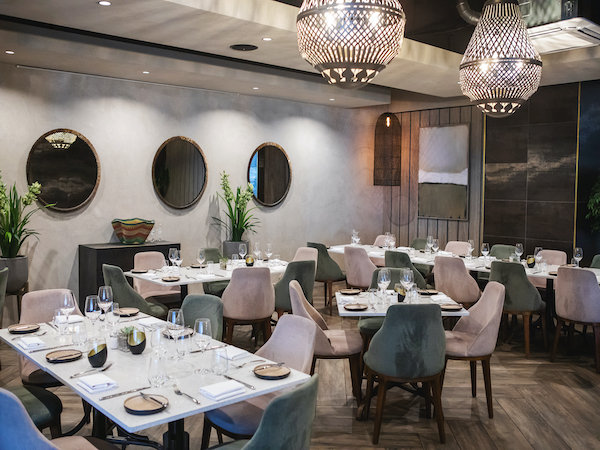
At Zest Restaurant the chefs work behind the open plan kitchen, with its wood fire grill, and can be seen whilst creating delectable dishes. Diners are able to...