


News


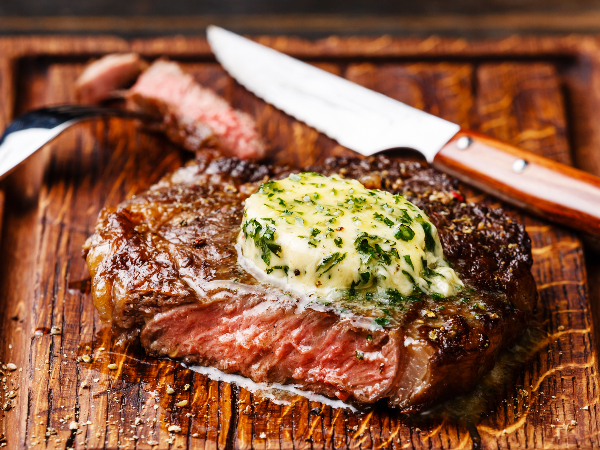
For much of the last decade, the global dining discourse has leaned plant-forward. Likely spurred on by a growing climate crisis, this notion has played out in the form of vegetable hero dishes on tasting menus, as seen at the now-closed NOMA, Arpège, and even Eleven Madison Park. Conversely, meat-heavy restaurants were quietly recast as old-world relics. And while some of these sentiments still ring true today, and ethical consumption remains top of mind for many, steakhouses are undeniably reasserting themselves. Shaking off the patina of outdated institutions, they are re-emerging as confident, design-led, ingredient-driven spaces – and now the steakhouse experience has never been cooler.
In South Africa, however, the story is slightly different. “Steak has always been one of the most popular dining choices globally, and particularly in South Africa,” says Vassilios Holiasmenos, chef and owner of The Blockman in Parkhurst, Johannesburg (listed in the World’s Best Steak Restaurants in 2025). “While steakhouses may be trending internationally, here they have never truly gone out of style.”
View this post on Instagram
Jarryd Segal, owner of NV-80 Grill & Bar in Sea Point, agrees that while there’s an obvious uptick in steakhouse popularity, what he’s noticed is a renewed appreciation for the experience. “The simplicity, the familiarity, and the approachability of this style of dining,” Jarryd explains. “People are gravitating toward restaurants that feel classic, reliable, and celebratory.”
Similarly, at Nelson’s Eye, one of Cape Town’s oldest and most iconic steakhouses, this appreciation sees diners becoming more adventurous. “Thanks to improved production methods and modern aging techniques, guests are increasingly interested in premium cuts and specialty options such as dry-aged beef, tomahawk steaks, Wagyu beef, and Wagyu ribs,” says general manager Brandon Jantjies. “It’s not just about ordering a standard steak anymore; guests want something memorable, and steakhouses are a natural fit for that.”
View this post on Instagram
The Blockman and Vuur in Stellenbosch (another restaurant on the World’s Best Steak Restaurants list) are two great examples of this innovation. Vuur’s steak offering includes many out-of-the-ordinary cuts, such as Denver, picanha, bavette, and tri-tip. Meanwhile, The Blockman experiments with multiple aging techniques, varying from 21 to 120 days and even whisky aging. “Our focus is constant exploration,” says Vassilios.
Beyond an increasing appetite for adventurous cuts, what else is driving this shift? Shaun Scrooby, head chef and owner of Vuur, says another trend could be the reason—the current protein craze. “Global trends are slowly moving towards more protein-based diets,” says Shaun. “I think the push for meat will only increase in popularity over the next few years.” He also touches on another interesting theory behind the steakhouse resurgence—nostalgia. “We love braaiing in this country, and so when we go out, we also love meat,” he says. “It’s that combination of more localized offerings, rather than defaulting to French or Asian cuisine.”
“It’s a combination of nostalgia and practicality,” agrees Jarryd. “Steakhouses are inherently crowd-pleasing and work well for mixed groups. While meat is central, most modern steakhouses offer broad, intentional menus that extend well beyond steak.” Brandon echoes this, adding that cost might also be a factor driving people to steakhouses. “High-quality meat has become far less accessible, and, on top of that, the cost of buying and cooking meat at home has increased significantly, so dining out for a great steak feels more worthwhile and more of an experience,” says Brandon.
View this post on Instagram
What’s clearly taking place here isn’t a revival, as much as a recalibration. The modern steakhouse is less about excess and more about intent—about provenance, aging, and a considered approach to meat.
Yet, South African steakhouses must be doing something distinctly different. “South Africans are, at heart, meat lovers. Braai culture adds a raw, authentic element to how we approach flavor and cooking,” says The Blockman’s Vassilios. “We are deeply experienced in handling and preparing meat—it’s second nature to us,” he explains. Jarryd adds that this braai culture, coupled with South Africa’s world-class quality beef, creates an authenticity that can’t be manufactured. “When you combine that with our diverse global culinary influences, you get steakhouse experiences that feel distinctly South African—familiar at their core, yet layered with global flavor in a nuanced and considered way.”
However, we can’t talk about a local dining experience without mentioning South African hospitality. “This is what gives a human element to our restaurants, which is very different to the rest of the world,” says Shaun.
So, perhaps the steakhouse was never really a trend to begin with. Or at least, not in South Africa, where fire is cultural currency, and high-quality beef is a cornerstone. Here, it remains a constant—evolving quietly in technique and ambition, while staying true to its primal appeal. While the rest of the world might be rediscovering a love for steakhouses, South Africa has simply been tending to it all along.


Related posts
-

-
Creating connection: Sommelier Tinashe Nyamudoka on finding beauty in wine
-
It's never just a drink with...
-
-
-
Enter now: The S.Pellegrino Young Chef Academy is open for applications
-
It's more than a culinary...
-
-

-
Announced: The Eat Out Special Awards
-
Stay updated on the Eat Out Woolworths Restaurant...
-
Promoted Restaurants
-

Cowfish
Cowfish is known for its Asian inspired burgers, sushi, dim sum and grills. Instagram:...
-

3 Kitch3ens at Silver Forest
3 KITCH3NS is a vibrant colourful Restaurant and Bar based at the Beautiful Silver Forest, at the foot of the Helderberg Mountain surrounded by Trees. As the name...
-

The Alba Harties Harbour
Welcome to Harties Harbour, situated in the Kommandonek Wildlife Resort, your one stop venue for the best that Hartbeespoort Dam has to offer. Daily Lunch and...
-

De Grendel Restaurant
De Grendel is an inner city wine farm restaurant that forms part of the Durbanville wine route. The estate is great for locals who want to experience a full...
-

Kleine Zalze Restaurant
Kleine Zalze Estate is a reputable producer of a wide range of quality wines. The Kleine Zalze Restaurant offers guests the opportunity to enjoy a relaxed,...
-

Grande Roche Restaurant
Grande Roche Restaurant is a grand old lady with a fresh set of pearls and vibrant lipstick. Chef Kevin’s food style is an ever evolving feeling and depends...